Why Scent Drive Challenges Beagle Leash Training

To stop leash pulling in Beagles, start with a front-clip harness, practice short five-minute training sessions using high-value food lures at your hip, and reward loose-leash walking with functional sniff breaks. That combination gives your hound a clear physical cue, a reason to check in with you, and a natural outlet for their nose.
Walking a Beagle can feel like walking a very determined, furry metal detector. The moment their nose hits the grass, their ears seem to turn off completely. That is not your dog being spiteful. It is pure biology.
Beagles possess roughly 220 million scent receptors in their noses, compared to our puny 5 million. When your hound catches wind of a neighborhood squirrel, a day-old pizza crust, or another dog's scent mark from yesterday morning, their brain enters a state of cognitive tunnel vision. The visual world fades away, and the olfactory world takes over completely.
Because they were bred for centuries to trail hares over rugged terrain without waiting for human permission, Beagles often rank low in standard trainability ratings (around 2 out of 5). They are independent problem solvers who follow an odor until they find its source.
When you attach a leash to that raw instinct, you trigger the opposition reflex. This is a canine's natural physical impulse to pull back against any pressure they feel on their neck or shoulders. If you yank, they lean harder into the pull.
Understanding how scent hounds operate is the secret to turning things around. If you want to dive deeper into breed-specific handling, check out our favorite scent-hound heel guide for added context.
Essential Gear Setup for Walking Scent Hounds
Before you step out the front door, having the right walking tools makes a world of difference. You cannot out-muscle a scent hound by pulling harder, so your gear needs to provide smart mechanical leverage while protecting your dog's airway.
First, toss out any retractable flexi-leads. Retractable leashes maintain constant tension, which actively teaches your hound that pulling forward unlocks more walking space. Instead, use a sturdy four-to-six-foot fixed nylon or biothane lead. A fixed lead gives clear, consistent boundaries.
You will also want a hands-free bait bag clipped to your belt. When you need to compete with the smell of wild rabbits, digging through your coat pockets for a crumbly biscuit will cost you precious seconds. Keep strong, fragrant rewards within immediate reach at your hip.
Harness and Collar Selection for Pulling Control
Standard flat buckle collars rest directly over a dog's delicate windpipe. When an excited Beagle hits the end of a flat collar at full speed, they risk tracheal damage, coughing fits, and neck strain.
For real control without airway pressure, we recommend a properly fitted front-clip harness. The leash attaches to a ring at the center of the dog's chest. When your hound surges forward, the harness gently pivots their shoulders back toward you, naturally redirecting their momentum without hurting their neck.
If your hound has a sleek head and a thick neck, they might easily slip out of standard gear. A martingale collar is another helpful option for escape prevention, as it gently tightens evenly around the neck when pulled without creating a choking effect.
| Gear Type | Pulling Control | Airway Protection | Best Use Case |
|---|---|---|---|
| Standard Flat Collar | Low (triggers opposition reflex) | Poor (direct tracheal pressure) | Holding identification tags |
| Front-Clip Harness | High (redirects forward momentum) | Excellent (distributes force across chest) | Daily loose-leash training and walks |
| Martingale Collar | Moderate (prevents backing out) | Good (distributes pressure evenly) | Dogs prone to slipping out of collars |
Step-by-Step Drills for Loose-Leash Walking
Training a hound requires short, upbeat micro-sessions. Long, exhausting training sessions lead to mental fatigue and stubborn stalling. We want frequent, five-minute drills that end on a winning note.
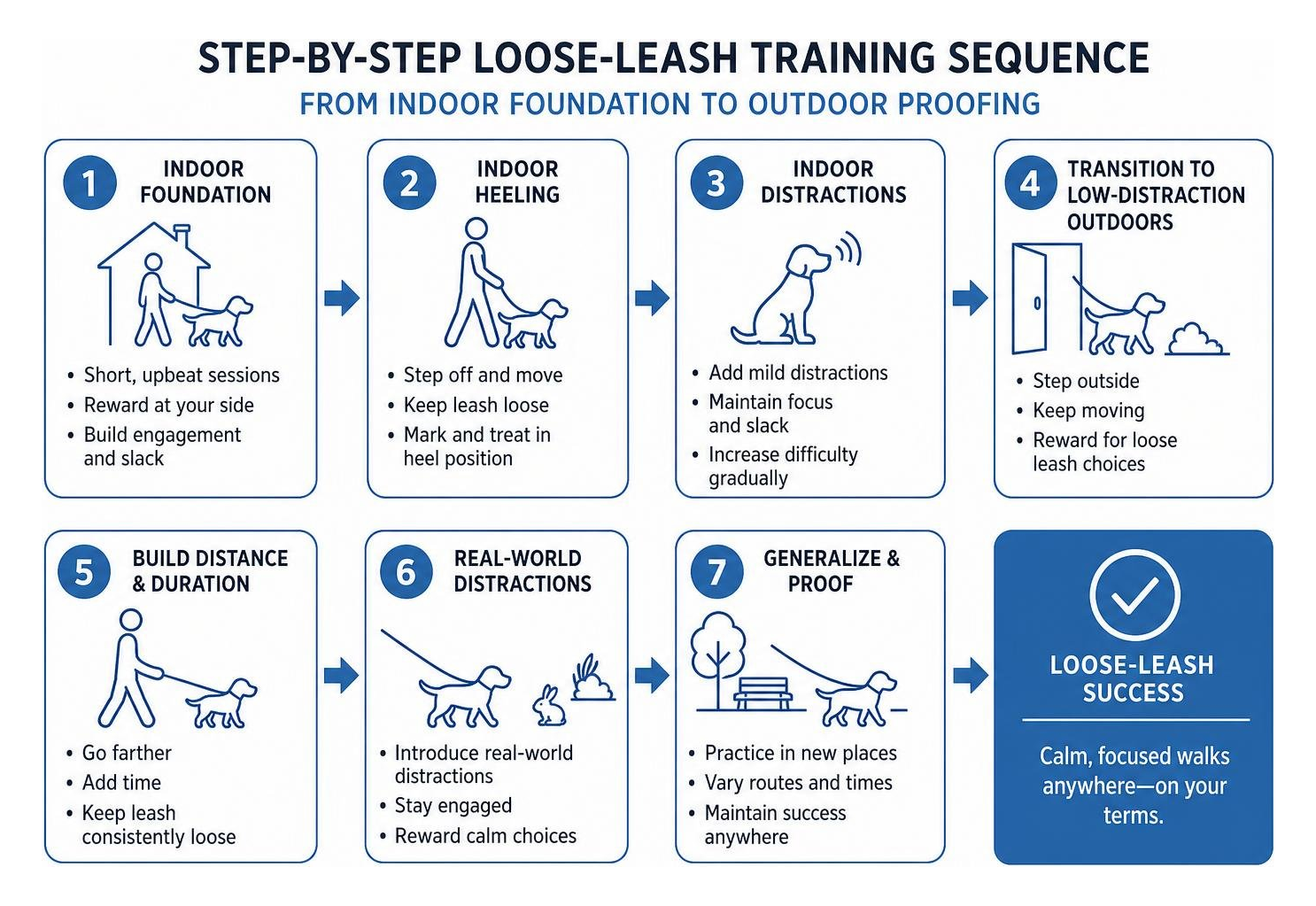
Always use clear verbal markers (like a crisp "Yes!") or a clicker the exact second your Beagle looks at you or lets the leash go slack. Deliver treats right at your outer seam at knee or hip level. This builds a high-value reinforcement zone right by your side.
Indoor Beagle Leash Training Foundations

Do not start training on a busy sidewalk full of birds and blooming flowers. Start in your quiet living room or hallway where there are zero competing smells.
- Introduce the gear with food: Let your puppy or adult dog sniff their harness. Pair putting the gear on with a meal or a high-value jackpot treat so the equipment predicts awesome things.
- Establish the hip zone: Stand still with your dog on a loose lead indoors. Hold treats at your side. Every time your dog steps into your 12-inch hip zone, mark "Yes!" and feed them directly against your pant leg.
- Take two steps forward: Move two paces. If the leash stays loose, mark and reward instantly. Keep your delivery rate high, rewarding every single step at first.
- Build duration: Gradually increase from two steps to five, then ten. Keep these indoor games to 5 to 10 minutes, running them two to three times a day.
If you are working with a brand-new puppy, setting up early habits through structured puppy training will save you months of frustration later on.
Transitioning Beagle Leash Training to Outdoor Environments
Once your hound walks happily by your hip indoors, step out into a low-distraction outdoor area like your driveway or a quiet backyard.
Outside, ground smells will instantly test your dog's focus. When your Beagle drops their nose and freezes on an odor, do not yank on the leash. Instead, use the 45-degree scent redirection sequence:
- Stop your feet: Plant your feet like a tree trunk the moment tension hits the line.
- Present the lure: Bring a piece of warm, aromatic freeze-dried liver right to your dog's nose.
- Lift the head: Smoothly guide the treat upward at a 45-degree angle toward your hip to physically lift their muzzle off the grass.
- Mark and reward: As soon as their head comes up and they take a step toward you, mark "Yes!" and reward at your side.
- Change direction: Turn 180 degrees and walk the other way, rewarding your dog for following your movement.
Following these vet-approved leash training steps helps bridge the gap between indoor practice and real-world walks.
Using Sniff Breaks as Functional Life Rewards
You will never eliminate a Beagle's desire to sniff, and you shouldn't want to! Sniffing provides critical mental stimulation and burns off excess energy. The trick is using sniff time as the ultimate reward for walking politely.
This leverages the Premack Principle: using a high-probability natural behavior (sniffing) to reinforce a lower-probability behavior (walking on a loose leash).
- Walk with your dog beside you on a loose leash for 15 to 20 paces.
- Stop near a nice patch of grass.
- Say your release cue, like "Go sniff!" or "Free dog!"
- Step forward with them and let them sniff whatever they want for 30 to 60 seconds.
- Say your walking cue ("Let's go"), lure them back to your side with a treat, and resume polite walking.
Balancing structured walking with sniffing helps meet your Beagle's daily 60-minute exercise need while keeping their brain happy. For more routine advice, browse our practical dog walking tips.
Troubleshooting Baying, Freezing, and Leash Biting
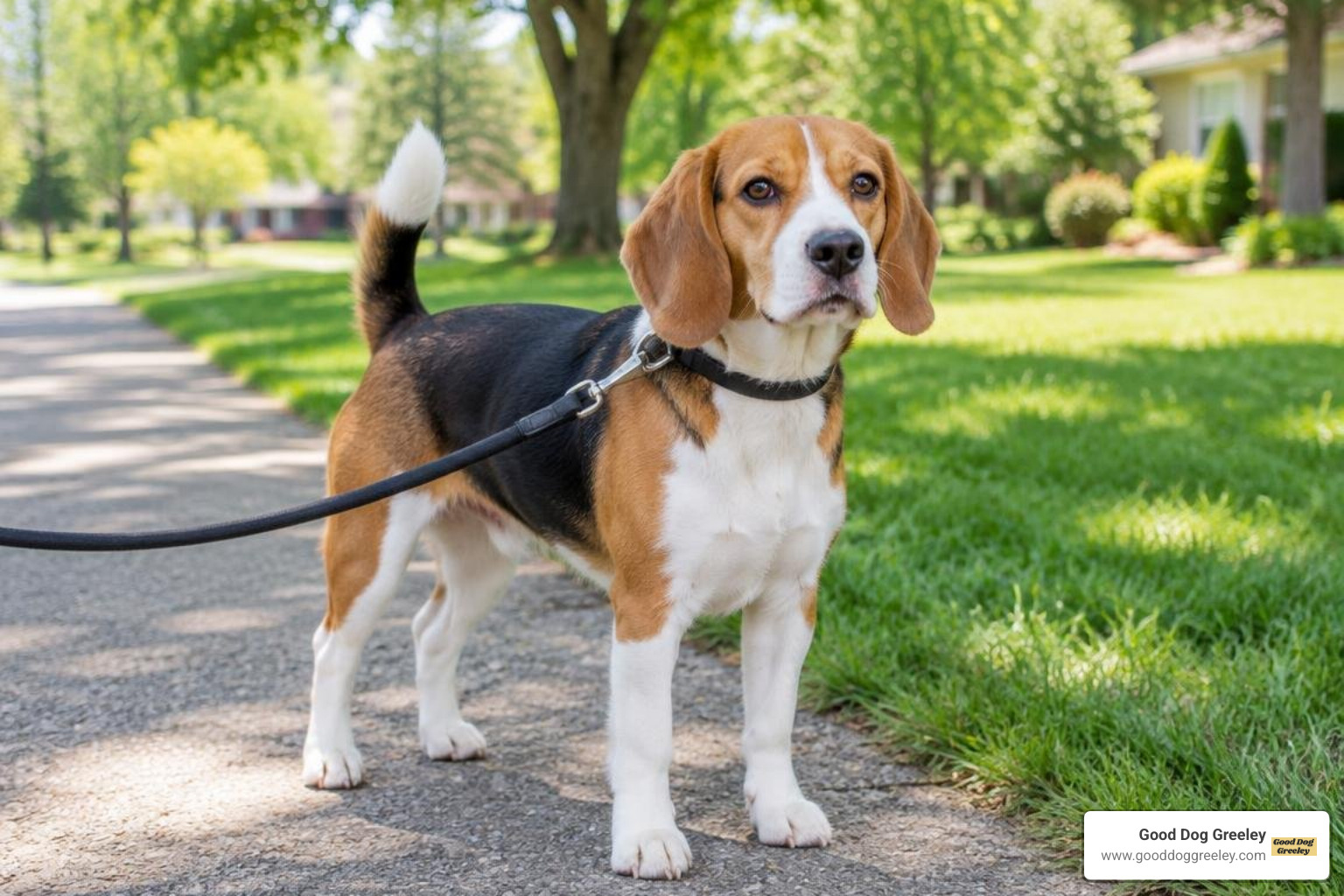
Even with solid practice, hound owners often run into a few classic breed quirks on the sidewalk. Let's tackle them one by one.
Correcting Leash Biting and Anchoring Mid-Walk
Some young Beagles get overstimulated and turn the leash into a game of tug-of-war, biting and thrashing the lead. If you pull back, you make the game fun.
Instead, drop all motion and use the dead-weight technique. Hold the leash firmly against your core without pulling back, making it completely boring. Alternatively, keep a second leash clipped to their harness. If they grab leash one, simply drop your hold on it and pick up leash two. When the resistance vanishes, the fun disappears.
If your hound drops their anchor and refuses to budge because they are locked onto an interesting trail, avoid dragging them. Step two feet to the side to break their straight line of sight, place a fragrant treat at their nose, and reward them the moment all four paws step forward with you.
Managing Baying, Whining, and Destructive Energy
When a Beagle catches a hot trail or spots a rabbit, they may let out a loud, musical bay. That vocalization is often rooted in excitement or barrier frustration.
Never yell back, as your dog will just think you are barking along with them. Instead, create distance from the trigger. Turn around smoothly, increase the space between your hound and the distraction, and reward quiet focus the moment their mouth closes.
If your dog is bubbling over with frustrated energy at home between walks, redirecting those jaws toward structured games can prevent household damage. Learn more about channeling that drive with our guide on training for destructive chewing.
Frequently Asked Questions About Walking Beagles
How long does it take to leash train a Beagle puppy versus an adult?
A young Beagle puppy practicing short, five-to-ten-minute sessions daily can grasp basic loose-leash foundations within 4 to 6 weeks.
For an adult Beagle with ingrained pulling habits, achieving a dependable, distraction-proof heel outdoors typically requires 3 to 6 months of daily practice. Consistency is what rewires those automatic muscle habits.
Can Beagles ever be safely walked off-leash?
In open, unfenced areas, most professional trainers advise keeping Beagles on a lead. Their intense prey drive and single-minded scent tracking mean that if a rabbit bolts, their recall can fail in a split second.
You can give your hound safe freedom by using a 30-foot biothane long line in open fields or practicing emergency whistle recalls in securely enclosed parks. If you are struggling with a hound that constantly tunes you out, exploring professional solutions for disobedient dogs can help build reliable boundaries.
What are the best high-value treats for scent-fixated Beagles?
Dry biscuits will not cut it when outdoor smells are strong. You need pungent, high-moisture treats that out-smell the environment:
- Freeze-dried beef or chicken liver
- Warm hot dog slivers
- Soft, moist liver sausages
- Salmon puree dispensed from a reusable squeeze tube
- Small cubes of sharp cheddar cheese
Rotate your treat selection regularly so your hound never knows what delicious surprise you have in store.
Working With Your Beagle's Nose
Leash training a Beagle is not about crushing their natural hunting instincts. It is about learning to cooperate with that incredible nose so you can both enjoy your daily strolls around the neighborhood.
With daily consistency, short reward-packed drills, and well-timed sniff breaks, your chaotic walks will quickly turn into calm, connected adventures.
If you are located in Northern Colorado and want hands-on support with structured walking or obedience, reach out to our team at Good Dog Greeley to find the right training path for your family.